Oil wins if you want to keep the timber looking like timber and don't mind touching it up every year or so. Stain wins if you'd rather correct patchy colour, fight UV damage harder, and stretch the gap between coats. Haymes Paint's own comparison of the two finishes backs this trade-off, and it flips once a deck is heavily weathered, mismatched, or built from treated pine, where stain's colour control usually beats oil's natural look.
TL;DR:
- Oil is best for sound, premium hardwoods that showcase natural grain, requiring annual touch-ups to maintain protection and appearance.
- Stain provides better UV resistance and longer intervals between coats, especially suitable for weathered, greyed, or treated pine decks.
- Recoating oil is easier and quicker, with spot repairs blending discreetly, whereas stain repairs are more complex and often visible.
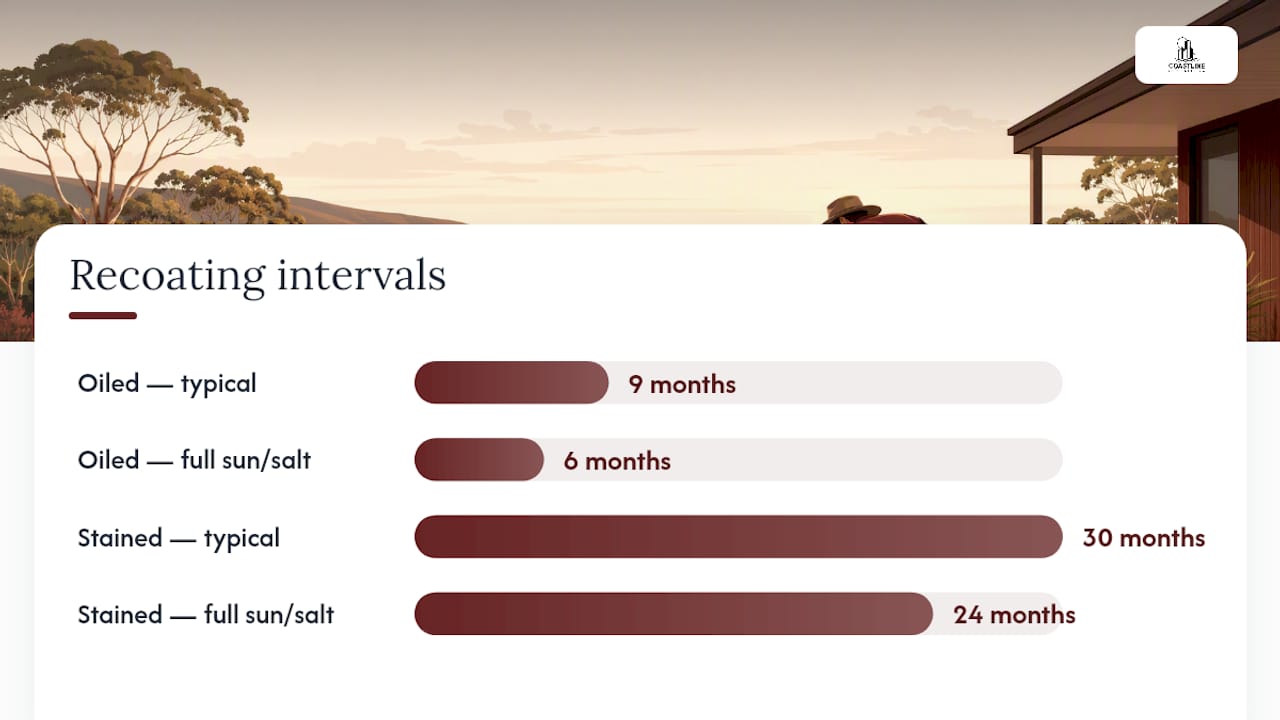
- Decks under full sun need more frequent maintenance, with oils every 6 to 12 months and stains lasting 2 to 3 years, depending on exposure.
- Structural issues must be addressed first, as neither oil nor stain can fix underlying timber rot, sagging, or poor drainage problems.
Table of Contents
- Decking oil vs stain: how each finish actually works
- Head-to-head: appearance, protection, durability and upkeep
- Matching the finish to your timber and its current state
- Prepping and applying your deck: the step-by-step
- Keeping the finish alive: maintenance and when to call it quits
- Quick checklist: pick your finish in five questions
- A practical note from a local carpenter
- Need the deck sorted properly, not just resurfaced?
- Sources
- FAQ
Decking oil vs stain: how each finish actually works
The core difference between decking oil and decking stain comes down to where the product sits once it's dry: inside the timber, or on top of it.
Decking oil is a penetrating finish. It soaks into the wood fibres rather than sitting on the surface, which is why it feeds and conditions the timber almost the way a leather conditioner works on a boot. Because it sinks in instead of forming a skin, it leaves the grain fully visible and gives you a low sheen, almost matte finish that reads as "natural timber" rather than "coated timber". Haymes notes that oils suit sound, premium boards where you want that raw grain to stay the hero.
Decking stain works differently. Most stains carry more pigment and resin than oils, which means they alter colour more assertively and, in some formulations, build a thin protective film on top of the wood rather than just soaking in. That extra pigment load is what gives stain its two big advantages: better UV resistance and the ability to even out colour on timber that's gone patchy or grey. The trade-off is that you see less of the timber's own character and more of the product's colour.
The variants you'll actually find on the shelf
Walk into any hardware store and "oil" or "stain" splits into several sub categories, and picking the wrong one inside that category causes almost as many headaches as picking the wrong finish type altogether.
- Clear decking oils highlight grain with minimal colour shift, best for premium hardwoods you want to look untouched.
- Coloured or tinted oils add a warm tone (often amber or reddish) while keeping the penetrating, matte character.
- Water-based oils and hybrids blend oil-like penetration with faster drying and lower odour, a genuinely useful middle ground Wattyl highlights for anyone doing the work themselves on a weekend.
- Transparent stains show grain clearly but adjust colour more than a clear oil.
- Semi-solid stains hide more of the timber's natural variation while still showing some grain texture.
- Solid stains behave closer to a thin paint, masking most grain in favour of full, even colour.
Sheen and feel change with each option too. Oils generally dry to a satin or matte touch that still feels like wood underfoot. Film-forming stains and solid stains can feel slightly harder or glassier, especially once several coats build up, and that surface is what eventually cracks or peels rather than just fading. That distinction between fading and peeling turns out to matter more than most people expect, and it's worth understanding before you buy either product.
Head-to-head: appearance, protection, durability and upkeep
Choosing between oil and stain really comes down to four things: how it looks, how well it protects the timber, how it fails over time, and how much of your weekends it eats up in upkeep.
Appearance is the most obvious split. Oil keeps the grain front and centre and tends toward natural, honey, or amber tones that shift subtly as the timber ages. Stain gives you far more control over the final colour, including the ability to push a tired grey deck back toward a rich brown or even a deliberately modern grey tone, but you lose some of the grain definition in the process, especially with semi-solid or solid formulations.
Protection favours stain on paper. The added pigment and resin block more UV radiation, which is the main reason timber decking fades and silvers in the first place. Moisture repellence is broadly comparable between quality oils and quality stains, though film-forming stains add a physical barrier layer that some oils don't. Mould and algae resistance depends more on the specific product's additives than on whether it's labelled oil or stain, so check the tin rather than assume.
Durability and failure mode is where the two genuinely part ways. Oil fades gradually and evenly, meaning a tired oil finish looks dull rather than damaged, and a fresh coat over the top blends in without much drama. Stain, particularly the film-forming end of the spectrum, fails differently: instead of gently fading it can crack, flake, or peel once UV and foot traffic break down that surface layer. Industry guidance on horizontal surfaces is blunt about this: paint performs worst of all on a deck because it forms a brittle film that can't handle standing water and constant foot pressure, and stain still tends to fade rather than peel, keeping it more forgiving than paint even when it does eventually let go in patches.
Maintenance frequency is the number most homeowners actually care about. Community reports and retailer guidance converge on oils needing a fresh coat roughly every 6 to 12 months in exposed Australian conditions, while many modern stains stretch to 2 to 3 years depending on the product and how much sun and rain the deck copes with. Some manufacturers push that gap even further: Haymes has noted that certain decking stains are formulated to last up to three times longer than a traditional oil, which is a genuine consideration if you'd rather not spend every second weekend with a paintbrush.
| Factor | Decking oil | Decking stain |
|---|---|---|
| Appearance effect | Natural grain stays visible, subtle colour shift | Stronger colour control, grain softened as pigment increases |
| UV/moisture protection | Good, but generally shorter lived | Usually stronger, especially higher pigment formulations |
| Maintenance frequency | Roughly every 6 to 12 months in harsh sun | Commonly 2 to 3 years depending on product |
| Prep difficulty | Lower, especially for spot touch-ups | Higher, particularly if recoating over old finish |
| Typical finish/feel | Matte, feels like natural timber | Satin to semi-gloss, can feel more like a coating |
Spot repairs are the other practical difference. Because oil soaks in rather than forming a layer, you can patch a worn section without stripping the whole deck, and the join between old and new oil is barely visible once it cures. Stain repairs are trickier, especially with film-forming types, because a patched area can show a visible line or sheen mismatch against the surrounding, older coating.
Matching the finish to your timber and its current state
Not every board on your deck is starting from the same place, and the right finish depends as much on the timber's species and condition as on your taste in colour.
Premium hardwoods such as jarrah, merbau, and spotted gum are usually the strongest case for oil. These timbers already carry rich natural colour and striking grain, so a penetrating oil lets that character do the work rather than covering it with pigment. If the boards are still in good structural shape with even colour, oil is typically the better fit, and it's the choice that keeps the deck looking like premium hardwood rather than a painted surface.
Treated pine tells a different story. Treated pine tends to have a flatter, less interesting grain to begin with, and it's more prone to going patchy or greenish as the preservative treatment weathers. Stain, particularly a semi-solid or solid variety, corrects that unevenness and gives treated pine a more deliberate, finished appearance than oil usually can.
Weathered or greyed timber is arguably the clearest case for stain regardless of species. Sun-bleached, silvery boards have already lost a lot of their natural colour depth, and oil will highlight that grey, tired look rather than disguise it. Stain's pigment can push the colour back toward something closer to the timber's original tone, or take it somewhere entirely new.
A few extra situations worth flagging:
- Decks with mismatched boards (repairs, replaced sections, or a mix of old and new timber) usually look better under stain, since it evens out colour differences that oil would leave visible.
- Water-based oils and hybrid formulations are a solid middle ground when you want most of oil's natural look with a bit more longevity and easier cleanup, a point Wattyl's guidance on Australian deck finishes backs up directly.
- If your deck sits under heavy shade with less UV exposure, oil's shorter lifespan matters less, since UV degradation is the main thing shortening its interval.
- If you're refinishing a deck that abuts a pergola or alfresco area, matching the finish type across both surfaces keeps the whole space looking cohesive rather than patchworked.
Switching from one finish to the other
Moving from stain to oil is generally straightforward once the old stain has weathered or been sanded back enough for the timber to accept a penetrating product. Moving the other way, from oil to stain, is the harder direction. Oil residues sit inside the timber's surface fibres and can repel a new stain, so industry advice on this is consistent: expect to wait out months of natural weathering, or actively strip the old oil, before a stain coat will adhere properly and evenly. Wood Finishes Direct's guidance on the switch is a good sense check before you commit to a colour change on an already-oiled deck.
Prepping and applying your deck: the step-by-step
Whichever finish you land on, preparation is what determines whether it lasts a year or three. Retailer and manufacturer guidance is remarkably consistent on this point: poor prep is the single most common cause of either oil or stain failing early.
- Clear and sweep the deck thoroughly, removing furniture, pot plants, and any loose debris caught between boards.
- Pressure wash on a moderate setting, holding the nozzle far enough back to clean without gouging the timber's soft grain, then let the boards dry completely, which usually takes 24 to 48 hours in good weather and longer in humid conditions.
- Check for old, flaking finish or grey, weathered fibres and sand these back or use a proprietary deck stripper where the surface won't accept a fresh coat cleanly.
- Run a water-drop test on a few boards once dry: if water beads up rather than soaking in within a minute or two, the timber isn't ready and needs further sanding or a longer drying window, a check Haymes recommends before committing to a full application.
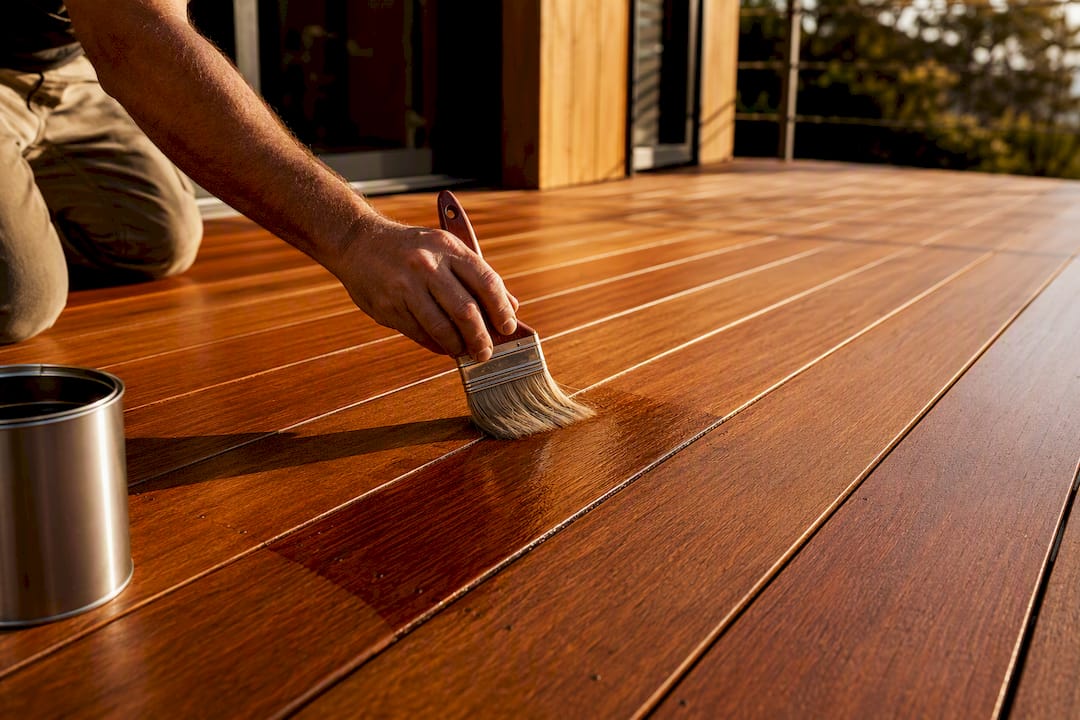
- For oil, apply with a brush, roller, or applicator pad, working with the grain and keeping a wet edge to avoid lap marks. Most oils go on in one generous coat, sometimes two if the timber is particularly thirsty, and you want it to soak in rather than pool on the surface. Wipe back any oil that hasn't absorbed within 15 to 20 minutes to avoid a sticky, uneven finish.
- For stain, apply thinner, more even coats, usually two, allowing the recommended recoat window on the tin (commonly 4 to 24 hours depending on the product and humidity) between applications. Pay close attention to edges and board ends, since these are the fastest-absorbing, most vulnerable points on any deck.
- Check the weather forecast before you start. Both finishes need a dry window of at least 24 to 48 hours after application, and neither should go on in direct, blazing midday sun, which can cause the product to dry too fast and lap-mark.
- Let the final coat cure fully before moving furniture back, typically 48 to 72 hours, longer in cooler or more humid conditions.
Pro Tip: Grooved or profiled decking boards need a stiff brush worked deliberately into each groove, not just a roller pass over the top. Rollers and foam pads glide straight over the recesses and leave raw, unprotected pockets that weather unevenly and show up as dark streaks within a season, a problem Homebuilding's guide flags as one of the most common DIY mistakes on grooved boards.
Keeping the finish alive: maintenance and when to call it quits
Once the finish is on, the real work is knowing when it needs attention again, and spotting trouble before it turns into a bigger repair job.
As a rough guide, oiled decks in full Australian sun often need a fresh coat every 6 to 12 months, while stained decks commonly run 2 to 3 years between recoats. Both ranges shift with exposure: a deck under a pergola or shaded by trees will stretch well past the low end of either range, while a north-facing deck copping full sun and salt air will sit at the shorter end regardless of which finish you chose.
A simple water-drop test tells you when it's time. Splash a little water on a worn-looking section, and if it soaks straight in rather than beading, the timber has lost its protective layer and it's time to recoat. Visually, look for dulling sheen, patchy dry spots, or the timber starting to feel rough and thirsty underfoot, all early signs worth acting on before the boards start greying again.
Common problems and how to read them:
- Peeling or flaking almost always points to a film-forming stain (or paint) breaking down, usually from moisture getting underneath the coating; the fix is stripping back to bare timber rather than coating over the peel.
- Patchy or uneven wear often shows up first in high-traffic zones like doorways and stair treads, and usually just needs a targeted spot recoat rather than redoing the whole deck.
- Mould or algae growth, especially in shaded, damp corners, needs a proper clean with a deck-specific cleaner before recoating, since sealing over active mould traps moisture underneath.
- Grey, silvery patches on an oiled deck usually mean the UV protection has worn through in that spot and it's overdue for attention, even if the rest of the deck still looks fine.
Some issues go beyond what a fresh coat can fix. If you're finding soft, spongy timber, boards that flex more than they should, or damage around joists and bearers, that's a structural problem, not a finishing one, and it's the point where a professional needs to assess the deck before any coating goes anywhere near it.
Quick checklist: pick your finish in five questions
Run through these before you buy a single tin:
- Do you want the natural grain to stay the star of the show, or do you need to correct patchy, uneven colour?
- Is the deck built from a premium hardwood in decent condition, or from treated pine that's started to grey?
- How much maintenance are you genuinely willing to do: a touch-up most years, or a bigger job every couple of years?
- Has the deck already got an oil or stain finish on it, and are you planning to switch types?
- Is the deck heavily shaded, or does it cop full sun and weather most of the day?
| Consideration | Decking oil | Decking stain |
|---|---|---|
| Natural look | Strong, grain stays visible | Reduced, especially with solid formulations |
| Longevity between coats | Shorter, roughly annual | Longer, often 2 to 3 years |
| Maintenance effort | Frequent but easy spot touch-ups | Less frequent, harder to spot repair |
| Prep difficulty | Lower for routine recoats | Higher, especially switching from oil |
A jarrah deck in good nick under a shaded pergola is a clear oil candidate. A treated pine deck that's gone grey and patchy after a few Perth summers is a clear stain candidate. Anything in between, a mixed-timber deck, a mismatched repair job, a deck you inherited and don't know the history of, is worth a closer look before you commit either way.
A practical note from a local carpenter
Most homeowners can handle a straightforward recoat on a sound, well-built deck, and there's no reason to call anyone in for that. Where it gets riskier is anything involving structural timber: soft joists, sagging bearers, or boards that have started to rot from underneath. That's not a coating problem, and no amount of oil or stain fixes timber that's already failing.
Some carpenters see many decks where the finish was the symptom people noticed first, but the actual issue was underneath: poor drainage, undersized bearers, or timber not rated for the exposure it faces. Professionals work on everything from full deck rebuilds to structural repairs before refinishing, and it's better to honestly identify when a deck needs framing work than to sell a recoat that won't hold.
If you're not sure whether your deck's problem is cosmetic or structural, it's worth a second opinion before you spend a weekend and a few hundred dollars on product that won't solve the real issue.
— Steven
Need the deck sorted properly, not just resurfaced?
If your deck's real problem is underneath the finish, a tin of oil or stain won't fix it. Handling structural issues like sagging joists, undersized bearers, or rot at the posts before recoating is essential to ensure the finish lasts as long as the product claims.
A site visit typically covers a full check of the timber's condition, honest advice on whether oil or stain suits your boards, and a clear picture of any structural work needed before refinishing goes ahead. From there you get a free, no-obligation quote, no pressure to sign anything on the spot. Our timber decking services cover everything from full deck builds to repairs and restoration ahead of a recoat, and if your project stretches into a pergola or alfresco area, our full services page covers that scope too. Get in touch for a quote and we'll tell you straight whether your deck needs a carpenter or just a weekend with a paintbrush.
Sources
- Decking oil vs stain
- Best deck finish — Oil vs acrylic vs water-based | Wattyl
- Decking oil vs stain: Weigh up the differences | Homebuilding
- How to choose decking oil, paint or stain | Bunnings
FAQ
Is it better to stain or oil a deck?
It depends on your priorities: oil suits homeowners chasing a natural timber look who don't mind annual touch-ups, while stain suits those wanting stronger colour correction and fewer recoats, often stretching to 2 to 3 years between applications. Weathered, greyed, or treated pine decks generally lean toward stain, while sound premium hardwoods lean toward oil.
Which is better for a timber deck, oil or stain, in terms of durability?
Stain generally offers stronger UV resistance and can be formulated to last up to three times longer than a traditional oil. Oil fades more gracefully and is easier to spot repair, while stain resists fading longer but can crack or flake once it does eventually break down.
What is the best oil to put on a deck?
There's no single best oil for every deck. Clear or lightly tinted penetrating oils suit premium hardwoods like jarrah or merbau where you want the grain to stay visible, while water-based hybrid oils are a solid choice for faster drying and easier cleanup on a DIY weekend.
What is the best finish for an outside deck?
The best finish matches your timber's condition and your maintenance tolerance rather than being a single universal product. Sound hardwood in good condition usually looks best under oil, while grey, patchy, or treated pine timber usually benefits more from stain's colour correction and longer recoat intervals.
Should I stain my deck if it's already been oiled?
Yes, but expect more prep work than a straightforward recoat, since oil residues can repel new stain until the timber has weathered or been stripped back. Trade guidance suggests allowing months of natural weathering or using a proper stripping product before stain will adhere evenly.